

Beyond Search
How Narrin Tags Turn Photos into Stories
MEMORY INTELLIGENCE
Manfred Maiers
6/16/20263 min read
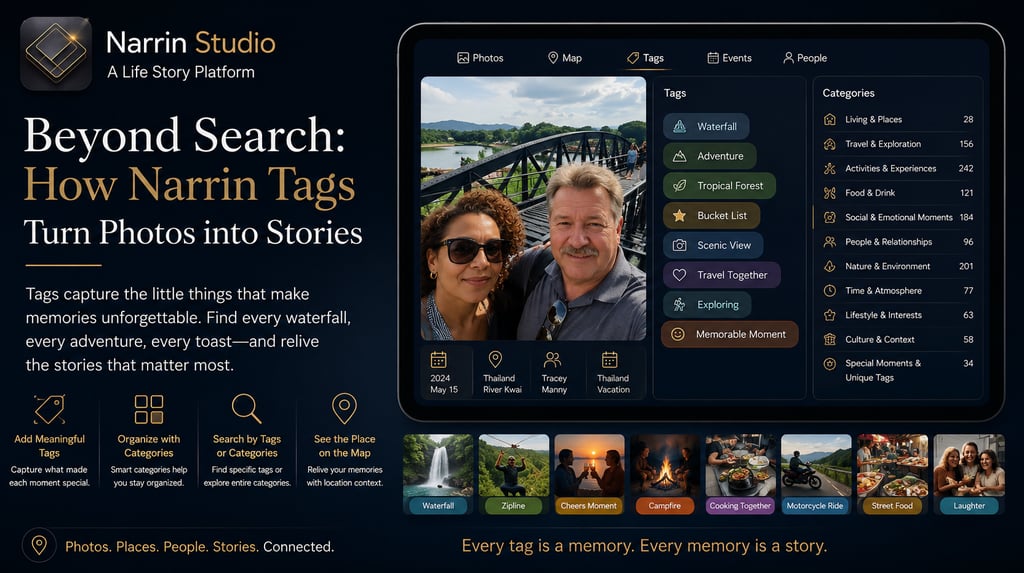

Beyond Search: How Narrin Tags Turn Photos into Stories
The Details We Forget First
Most of us have thousands of photos stored across phones, cloud drives, external hard drives, and old computers.
The photos remain.
The details disappear.
You might remember a trip to Costa Rica.
You might remember a family vacation to Hawaii.
You might even remember where the photos were taken.
But do you remember:
The waterfall you hiked two hours to reach?
The zipline that terrified everyone except your daughter?
The roadside coffee shop you still talk about today?
The toast you shared while watching the sunset?
The local market where you discovered your favorite meal?
These are often the details that made the memory special.
Unfortunately, they are also the details most photo software completely ignores.
Why Search Alone Isn't Enough
Modern photo apps are becoming increasingly intelligent.
You can search for:
Beach.
Mountain.
Dog.
Flower.
Food.
Artificial intelligence can identify objects, landscapes, and even faces.
But memories are not built from objects.
They are built from experiences.
A photo application might identify a glass of wine.
But it cannot know:
"This was the anniversary toast Tracey and Manny shared while overlooking the Caribbean at sunset."
A photo application might identify a waterfall.
But it cannot know:
"This was the waterfall they hiked three miles through the jungle to see."
The difference is significant.
One identifies objects.
The other captures stories.
This is where Narrin takes a completely different approach.
Introducing Narrin Tags
Narrin uses Tags as part of its Memory Context system.
While:
Locations explain where a memory happened.
Events explain why a collection of photos exists.
People explain who shared the experience.
Tags explain:
What made this moment memorable?
Tags capture the unique details that transform an ordinary image into a meaningful story.
Examples include:
Waterfall.
Zipline.
Campfire.
Cheers Moment.
Cooking Together.
Street Food.
Motorcycle Ride.
Wine Tasting.
Wildlife Encounter.
Family Tradition.
Years later, these details become powerful memory triggers.
Objects vs Stories
Imagine a photo of two people raising glasses together.
Traditional AI sees:
People.
Drinks.
Restaurant.
Narrin sees:
Cheers Moment.
Anniversary.
Sunset.
Caribbean Cruise.
Tracey and Manny.
One system identifies objects.
The other preserves meaning.
This distinction is what makes Narrin a Life Story Platform rather than simply a photo organizer.
The Power of Tag Categories
As photo collections grow, individual tags become even more valuable when organized into categories.
Narrin allows users to organize tags into meaningful groups.
Living & Places
Examples:
cabin
home
lake house
backyard
Travel & Exploration
Examples:
waterfall
sightseeing
river cruise
hiking trail
Activities & Experiences
Examples:
zipline
kayaking
snorkeling
fishing
Food & Drink
Examples:
cooking
wine tasting
local cuisine
cheers moment
Social & Emotional Moments
Examples:
laughter
celebration
friendship
anniversary
People & Relationships
Examples:
family tradition
reunion
father daughter
best friends
Nature & Environment
Examples:
flowers
mountains
tropical forest
wildlife
Time & Atmosphere
Examples:
sunrise
sunset
rainy day
golden hour
Lifestyle & Interests
Examples:
motorcycles
photography
boating
gardening
Culture & Context
Examples:
temple visit
local market
historical site
festival
Special Moments & Unique Tags
Examples:
proposal
bucket list
once in a lifetime
first kiss
A Lifetime of Waterfalls
Imagine your family has visited waterfalls in:
Hawaii.
Costa Rica.
Thailand.
Iceland.
Traditional photo systems see four unrelated trips.
Narrin sees one connected story.
Tag:
Waterfall
With a single search, Narrin can instantly assemble years of adventures into one memory collection.
Not because the photos were taken at the same place.
But because they share the same experience.
Cheers Moments
One of the most powerful examples involves something simple.
A toast.
Tracey and Manny enjoy sharing a drink together while traveling.
Over the years, these moments occur across:
Thailand.
Mexico.
Minnesota.
Cruise vacations.
Local restaurants.
Each photo receives the tag:
Cheers Moment
Years later, Narrin can instantly gather every toast, celebration, and shared drink into a single collection.
A collection that would otherwise remain hidden across thousands of unrelated photos.
The result is not search.
It's storytelling.
Rediscovering Adventures
Imagine searching:
"Show me all Activities & Experiences."
Narrin could instantly assemble:
Ziplining in Costa Rica.
ATV riding in Mexico.
Jet skiing in Florida.
Mountain biking in Colorado.
River rafting in Tennessee.
Years of adventures appear together, connected through shared experiences rather than dates or locations.
This type of discovery is impossible in traditional photo management systems.
The Complete Memory Story
The real power of Narrin emerges when tags work together with the rest of the Memory Context system.
A single photo might contain:
Photo:
A waterfall.
Location:
River Kwai, Thailand.
People:
Tracey and Manny.
Event:
Thailand Vacation.
Tags:
Waterfall.
Adventure.
Tropical Forest.
Bucket List.
Suddenly the image becomes much more than a photograph.
It becomes a complete memory story.
The Future of Memory Discovery
Traditional photo software asks:
"What is in this picture?"
Narrin asks:
"Why does this memory matter?"
That simple difference changes everything.
People rarely search for photos.
They search for experiences.
They search for stories.
They search for the moments that shaped their lives.
Narrin Tags preserve those moments.
Not as keywords.
Not as metadata.
But as memory anchors that help reconnect people with the stories hidden inside their photo collections.
Because years from now, you may not remember every destination.
You may not remember every date.
But you'll remember the waterfall.
The campfire.
The toast.
The adventure.
The moment.
And that's exactly what Narrin was built to preserve.