

Building the Narrin Database
Creating the Foundation for Connected Memories
PRODUCT DEVELOPMENT UPDATES
Manfred Maiers
6/1/20264 min read
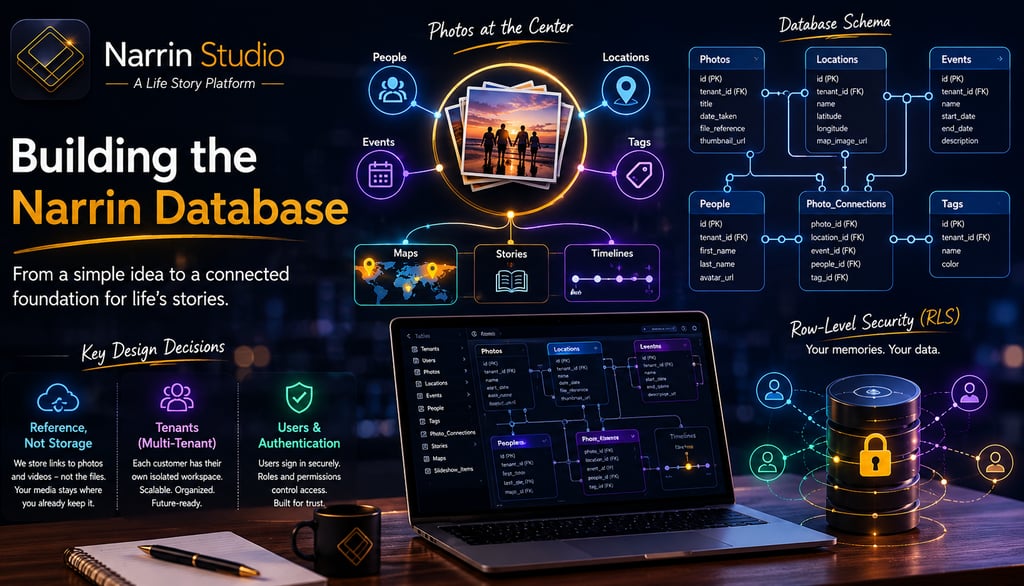
Building the Narrin Database
Creating the Foundation for Connected Memories
When people think about Narrin, they usually see the visual side of the platform.
They see:
photos.
maps.
events.
people.
timelines.
tags.
stories.
What they don't see is the technology underneath that makes those connections possible.
Today I'd like to share part of the journey of building the Narrin database and some of the key decisions that shaped the platform from the very beginning.
It Started with a Simple Question
Narrin began with a realization that many of us have experienced.
Modern phones and cloud services allow us to store thousands, sometimes tens of thousands, of photos.
But finding a specific memory years later can be surprisingly difficult.
You might remember:
who was there.
where it happened.
why it was important.
But your photo library usually only knows one thing:
A file exists.
The image contains a tremendous amount of meaning, but very little of that meaning is actually stored or connected.
That observation led to a simple idea:
What if photos could become the center of a connected memory ecosystem?
Beyond the Photo
Traditional photo systems treat the image itself as the primary object.
Narrin approaches the problem differently.
The photo remains at the center, but it becomes connected to other pieces of information that provide context and meaning.
For example, a single photo can be connected to:
Locations
Where was the photo taken?
Not just a city name, but a meaningful place.
Events
Was it part of:
a vacation?
a wedding?
an anniversary?
a graduation?
a family gathering?
People
Who appears in the memory?
Who shared the experience?
Who should be connected to that story?
Tags
Keywords that help organize and describe memories.
Examples:
vacation
family
favorite
beach
adventure
Suddenly the photo becomes much more than an image.
It becomes part of a story.
Locations Needed More Than Coordinates
One of the earliest design discussions centered around locations.
Most systems simply store GPS coordinates.
That wasn't enough.
When people remember a place, they don't think in latitude and longitude.
They think visually.
They remember:
islands.
cities.
beaches.
landmarks.
neighborhoods.
This led to another important idea:
Locations should have their own visual identity.
That meant introducing maps as first-class elements within Narrin.
A location isn't simply a database record.
It can also be represented by a map image that helps tell the story of where the memory happened.
This decision became one of the key foundations of the Narrin storytelling experience.
Should Photos Live Inside the Database?
One of the biggest architectural discussions came early in the project.
Should Narrin store photos directly inside the database?
Many applications do exactly that.
At first glance it seems convenient.
Everything is stored in one place.
But as we explored the idea further, it became clear that it wasn't the right approach.
The Reality of Modern Photo Libraries
Most users already have their photos stored in systems such as:
Apple iCloud Photos.
Google Photos.
Google Drive.
Microsoft OneDrive.
NAS devices.
local storage systems.
These platforms already do an excellent job storing and protecting files.
Narrin didn't need to replace them.
Narrin needed to complement them.
A Different Approach
Instead of storing images inside the database, Narrin stores references to them.
Think of it as a highly intelligent index.
The original files remain where they already live.
Narrin simply knows:
where the photo is located.
who is in it.
where it was taken.
what event it belongs to.
how it connects to other memories.
This approach offered several advantages:
no duplicate photo libraries.
smaller and faster database operations.
easier scalability.
freedom for users to choose their preferred storage provider.
Most importantly:
Narrin could focus on storytelling rather than becoming another cloud storage platform.
The Introduction of Tenants
As the concept matured, a new challenge emerged.
How would Narrin support multiple customers?
This introduced the concept of tenants.
What Is a Tenant?
In simple terms, a tenant represents an individual customer account or organization within the platform.
Every memory, story, person, event, location, and slideshow ultimately belongs to a specific tenant.
This ensures that:
data remains organized.
customer information remains separated.
future subscription models become possible.
the platform can scale safely.
Adding tenants was a major milestone because it transformed Narrin from a personal proof of concept into a true multi-user platform.
Then Came Users
Once tenants existed, another question naturally followed.
How do people access their stories?
That required introducing users.
A tenant may eventually contain:
one individual.
a couple.
an entire family.
multiple contributors.
Each person requires secure access to the platform.
This introduced:
user accounts.
authentication.
permissions.
account management.
At this stage Narrin started to feel less like a database project and more like a real software platform.
Protecting Every Family's Memories
As multiple users and tenants entered the system, security became increasingly important.
Family memories are personal.
People need confidence that their stories remain private and protected.
This led to the implementation of Row-Level Security (RLS).
Without diving into technical details, RLS helps ensure that users only see data they are authorized to access.
In practical terms:
Your memories stay yours.
Another family cannot accidentally access your stories.
And your data remains isolated within your own environment.
For Narrin, this was a critical step toward building a platform that people can trust.
Building for the Future
Looking back, it's fascinating how the database evolved.
The original concept was simply:
"Let's add more information to photos."
But every decision led to another layer of possibility.
Photos became connected to:
people.
places.
events.
maps.
tags.
stories.
Then came:
external media storage.
tenants.
users.
authentication.
security.
Each layer moved Narrin closer to its ultimate vision:
A platform that transforms disconnected photos into connected life stories.
The Foundation Is Now in Place
Today, the Narrin database serves as the foundation for:
Narrin Studio
The Life Story Platform.
Where memories are organized, enriched, and connected.
Narrin View
Watch your story unfold.
Where connected memories become immersive storytelling experiences.
The database may never be the most visible part of Narrin.
But it is the engine that makes everything else possible.
And while users may never see the thousands of design decisions behind it, every photo, person, place, event, and story depends on those foundations being built correctly.
The result is not just a photo management system.
It's the beginning of a new way to preserve and experience life's stories.
Because every photo tells a story.
Narrin helps you connect them.