

Developing the First Narrin Proof of Concept
How a simple idea about adding meaning to photos became the foundation of a new Life Story Platform
PRODUCT DEVELOPMENT UPDATES
Manfred Maiers
6/2/20266 min read
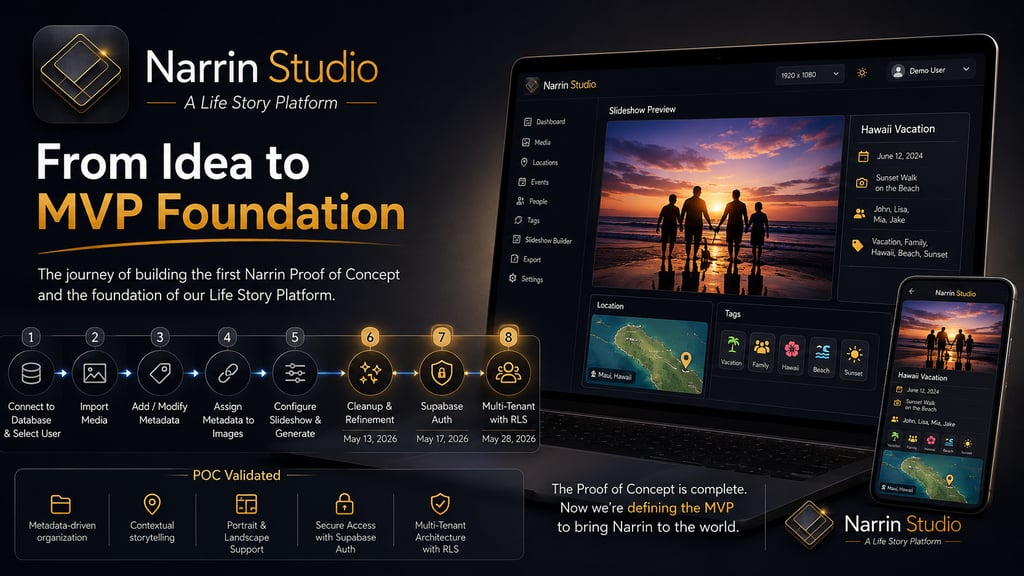
Developing the First Narrin Proof of Concept (POC): From Idea to MVP Foundation
How a simple idea about adding meaning to photos became the foundation of a new Life Story Platform
Every startup reaches a point where ideas, sketches, diagrams, and discussions are no longer enough.
At some point, you have to build something real.
For Narrin, that moment arrived in the spring of 2026.
By then, the core concept had already taken shape.
We had:
defined the vision.
designed the database architecture.
connected photos to people, places, events, and tags.
filed a patent application.
validated that nothing quite like Narrin existed in the market.
But there was still a critical question:
Would people actually find value in seeing their memories connected this way?
To answer that question, we needed a Proof of Concept.
The Original Name
Interestingly, the first version wasn't called Narrin.
The working title was:
Contextual Digital Media Display System
A name that was technically accurate, but admittedly not very memorable.
The concept was straightforward:
Take ordinary photos and enrich them with contextual information that helps explain the story behind the image.
Instead of simply displaying a picture, the system would also show:
where it was taken.
when it happened.
what event it belonged to.
who was involved.
how it connected to other memories.
The goal was to determine whether this additional context actually improved the viewing experience.
The Database Needed a Front End
At this point, we already had a functioning backend database.
The database could store:
media records.
locations.
events.
people.
tags.
relationships between them.
But a database by itself is not a product.
Someone needed a way to:
browse photos.
assign metadata.
create events.
connect people.
build stories.
generate slideshows.
This became the primary objective of the POC.
Build a desktop application that could interact with the database and demonstrate the complete storytelling workflow.
Starting Small
One of the most important decisions during development was to keep the scope intentionally limited.
Many startups fail because they try to build the final product immediately.
Instead, we focused on answering a specific question:
Can connected metadata transform the way people experience their photos?
The first POC concentrated on:
photo registration.
metadata assignment.
slideshow creation.
story rendering.
Nothing more.
No mobile apps.
No synchronization.
No advanced cloud services.
No social sharing.
Just the minimum functionality needed to validate the concept.
The Original Scope
The Proof of Concept focused on validating several core assumptions:
✅ Metadata-driven media organization.
✅ Filter-based slideshow generation.
✅ Visual storytelling through contextual information.
✅ Exporting completed story slideshows for viewing on digital devices.
The POC was intentionally designed around pre-rendered composite images rather than dynamic playback.
This allowed us to focus on validating the storytelling experience rather than building a complete playback engine.
The primary objective was simple:
Can a photo become more meaningful when connected to its story?
The Development Phases
The application's menu structure naturally evolved into the development roadmap.
Each menu section represented a major milestone.
Phase 1
Database Connection and Media Selection
The first challenge was simply connecting to the database and allowing users to browse local media.
Users could:
connect to the backend database.
select a user environment.
browse local image folders.
At this stage the goal was proving that the front end and backend could communicate reliably.
Phase 2
Import Media
Next came media registration.
Users needed a way to import photos and register them within the system.
This included:
single image imports.
bulk imports.
media record creation.
file reference management.
This phase also validated one of Narrin's most important architectural principles:
The database stores references to media files, not the files themselves.
Phase 3
Metadata Management
Once photos existed in the system, users needed a way to create the contextual building blocks.
This included:
locations.
events.
people.
tags.
These became the foundation of every future story.
For the first time, users could begin building a connected memory ecosystem.
Phase 4
Assign Metadata to Images
This was where the magic started to happen.
Users could connect:
photos to locations.
photos to events.
photos to people.
photos to tags.
A collection of disconnected images suddenly became a collection of connected memories.
The relationships became visible.
The stories started to emerge.
Phase 5
Slideshow Creation and Rendering
This phase brought the Narrin vision to life.
Users could:
select filters.
build story collections.
define slideshow criteria.
generate final slideshow images.
The rendering engine created composite storytelling images containing:
the original photo.
location information.
event information.
dates.
people.
tags.
For the first time, memories were presented with context rather than simply displayed as pictures.
The First Big Breakthrough
One of the most exciting moments occurred when the first composite image rendered successfully.
Instead of seeing:
IMG_2458.JPG
Users saw:
📍 A map showing where the memory happened.
📅 The date and event.
👥 The people who shared the experience.
🏷️ Tags describing the moment.
📸 The original photo.
The image suddenly felt different.
The memory had meaning.
The story became visible.
This was the moment when Narrin stopped feeling like a database project and started feeling like a storytelling platform.
Supporting Portrait and Landscape Displays
As development continued, another important realization emerged.
People consume memories on many different devices:
digital picture frames.
tablets.
laptops.
monitors.
televisions.
Some displays are portrait.
Others are landscape.
To support future Narrin View experiences, the rendering engine was expanded to support both orientations.
Landscape
1920 × 1080
Portrait
1080 × 1920
The layout automatically adapted while preserving:
panel hierarchy.
spacing.
visual consistency.
storytelling structure.
This became one of the most important steps toward supporting real-world viewing environments.
Phase 6
Cleanup and Product Preparation
Completed: May 13, 2026
As the POC matured, attention shifted from functionality to refinement.
This phase focused on:
fixing outstanding issues.
supporting both portrait and landscape orientations.
updating colors to match the Narrin brand.
refining terminology.
improving presentation quality.
preparing demonstration materials.
updating the interface for future MVP planning.
At this stage, the application began looking less like an internal prototype and more like an actual product.
The completion of Phase 6 marked the transition from feature implementation to product readiness.
Phase 7
User Authentication with Supabase Auth
Completed: May 17, 2026
The original POC intentionally avoided authentication in order to simplify development and focus on validating the storytelling concept.
As Narrin evolved into a production-ready platform, secure user access became essential.
Phase 7 introduced full integration with Supabase Authentication.
Capabilities implemented included:
user registration.
secure login.
password recovery.
session management.
user profile management.
protected application access.
This phase established the foundation for secure personal and family memory management.
For the first time, Narrin supported real user authentication and secure access control.
Phase 8
Multi-Tenant Architecture and Row-Level Security
Completed: May 28, 2026
The final phase of the POC transformed Narrin from a single-user prototype into a scalable multi-user platform.
Phase 8 introduced:
tenant creation.
user assignment.
tenant membership management.
role-based access control.
multi-tenant architecture.
Row-Level Security (RLS) across the database.
The architecture now follows:
Customer Account
↓
Tenant
↓
Tenant Membership
↓
User
This framework enables:
individuals.
couples.
families.
future subscription models.
enterprise scalability.
Row-Level Security (RLS)
One of the most important achievements of Phase 8 was the activation of Row-Level Security across the platform.
Without exposing technical implementation details, RLS ensures that every database request is automatically filtered according to the user's permissions.
The result is simple:
users only see their own data.
families only access their own memories.
customer accounts remain isolated.
security is enforced directly at the database layer.
For a platform built around personal memories and family stories, this milestone was critical.
The POC Is Complete
On May 28, 2026, with the completion of Phase 8, the Narrin Proof of Concept officially reached completion.
What began as a simple idea about enriching photos with context successfully evolved into a fully functioning platform capable of:
✅ Managing media libraries.
✅ Connecting photos to locations, events, people, and tags.
✅ Generating contextual storytelling slideshows.
✅ Supporting portrait and landscape storytelling layouts.
✅ Authenticating users.
✅ Managing tenants and memberships.
✅ Protecting customer data through Row-Level Security.
Most importantly, the POC validated the core Narrin vision:
Photos become significantly more meaningful when connected to the stories behind them.
What We Learned
The POC taught us something important.
People do not simply remember photos.
They remember:
the people.
the places.
the experiences.
the emotions.
the stories.
A photo is often just the starting point.
The meaning lives in the context around it.
Every major design decision throughout the POC reinforced this belief.
The Next Chapter: The MVP
With the POC now complete, development enters an exciting new phase.
The focus has shifted from proving the concept to defining and building the Minimum Viable Product (MVP).
The MVP will transform the successful Proof of Concept into the first production-ready versions of:
Narrin Studio
The Life Story Platform
and
Narrin View
Watch your story unfold
The MVP will focus on:
improved user experience.
production-quality workflows.
scalability.
performance.
onboarding.
cloud integration.
early-access customer readiness.
Kickstarter preparation.
The question is no longer:
"Can we build it?"
The POC answered that question.
The new question is:
"How do we make it remarkable?"
That journey has now begun.
Looking Back
From a simple idea about adding metadata to photos...
To a patent application...
To a database...
To a working Proof of Concept...
To a fully secured multi-tenant platform...
The journey has been incredibly rewarding.
And this is still only the beginning.
Because every photo tells a story.
Narrin helps you connect them.