

Events vs. Tags
Two different purposes. One connected life story.
MEMORY INTELLIGENCE
Manfred Maiers
7/11/20264 min read
Events vs. Tags
The Secret to Turning Your Photos Into Connected Life Stories
Most of us have thousands, sometimes tens of thousands, of digital photos.
We organize them into folders.
We create albums.
We search by date.
Yet years later we still ask ourselves:
"When was this taken?"
"Who was with us?"
"Was this before or after our South Africa trip?"
"Which restaurant was this?"
The problem isn't that we have too many photos.
The problem is that most photos have very little context.
That's exactly why Narrin Studio was built.
Instead of simply organizing pictures, Narrin organizes memories.
One of the biggest differences between Narrin and traditional photo organizers is its use of Events and Tags.
Although they sound similar, they have very different jobs.
Understanding the difference is one of the keys to building a rich, connected life story.
Think of Your Life Like a Book
Imagine your life as a book.
A book has chapters.
Each chapter contains many stories.
Those stories contain people, places, emotions, and details.
Narrin works the same way.
Events create the chapters.
Tags describe the details inside each chapter.
Together they create context that traditional photo albums simply can't provide.
Events Answer One Important Question
What chapter of my life does this memory belong to?
An Event gives a memory its place in your life's timeline.
Examples include:
South Africa 2026.
Alaska Cruise 2025.
Maui Wedding.
Tyler's Graduation.
Christmas 2025.
Aruba Anniversary Cruise.
Each represents a unique period in time with a beginning and an end.
When you browse one of these Events in Narrin, you're not just viewing photos.
You're reliving an experience from start to finish.
But Life Isn't Made Only of Big Events
Some of our happiest memories don't happen during vacations or celebrations.
They're much simpler.
Walking the dog.
Dinner with your spouse.
Coffee with friends.
Relaxing on the patio.
Watching a sunset.
These moments matter just as much.
That's why Narrin introduces Generic Events.
Examples include:
Everyday Moments.
Family Memories.
Home Life.
Local Adventures.
Weekend Memories.
These are not activities.
They are chapters of everyday life.
They provide meaningful context without forcing you to invent a unique event name every time you take a picture.
Tags Tell the Rest of the Story
If Events organize chapters, Tags describe what makes each memory unique.
Tags answer a different question:
What is happening in this photo?
Examples include:
Safari.
Sunrise.
Cheers Moments.
Favorite.
Wildlife.
Restaurant.
Grand Canyon.
Hiking.
Flowers.
Baseball.
Motorcycle.
Unlike Events, Tags are designed to connect photos across many years, locations, and experiences.
A photo taken in South Africa and another taken in Yellowstone may both carry the Wildlife tag.
A sunset in Hawaii and another in Arizona may both carry the Sunset tag.
Years later, one search instantly brings them together.
A Real-World Example
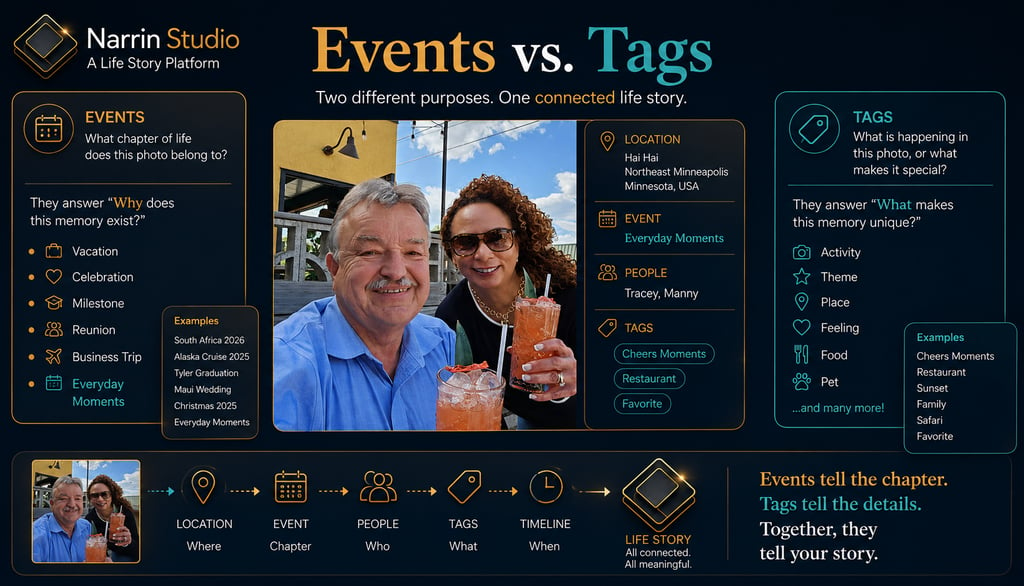
Recently, Tracey and I enjoyed a relaxing Saturday afternoon at Hai Hai, a Southeast Asian restaurant in Northeast Minneapolis.
The photo itself captures two smiling faces and a pair of colorful drinks.
Without context, that's all it is.
With Narrin, it becomes much richer.
Location
Hai Hai, Northeast Minneapolis
Event
Everyday Moments
People
Tracey, Manny
Tags
Cheers Moments.
Favorite.
The Event tells us where this memory fits within our life's story.
The Tags tell us what made this moment memorable.
Why This Difference Matters
Imagine asking Narrin:
Show me all of our Everyday Moments.
You'll see:
Walks with Sasha.
Lunch dates.
Patio dinners.
Coffee mornings.
Relaxing weekends.
Now ask a different question.
Show me every Cheers Moment.
Now Narrin gathers:
Anniversary dinners.
Birthday celebrations.
Vacation cocktails.
Rooftop bars.
Spontaneous afternoons with friends.
The exact same photo appears in both collections.
But for completely different reasons.
Events Build Timelines
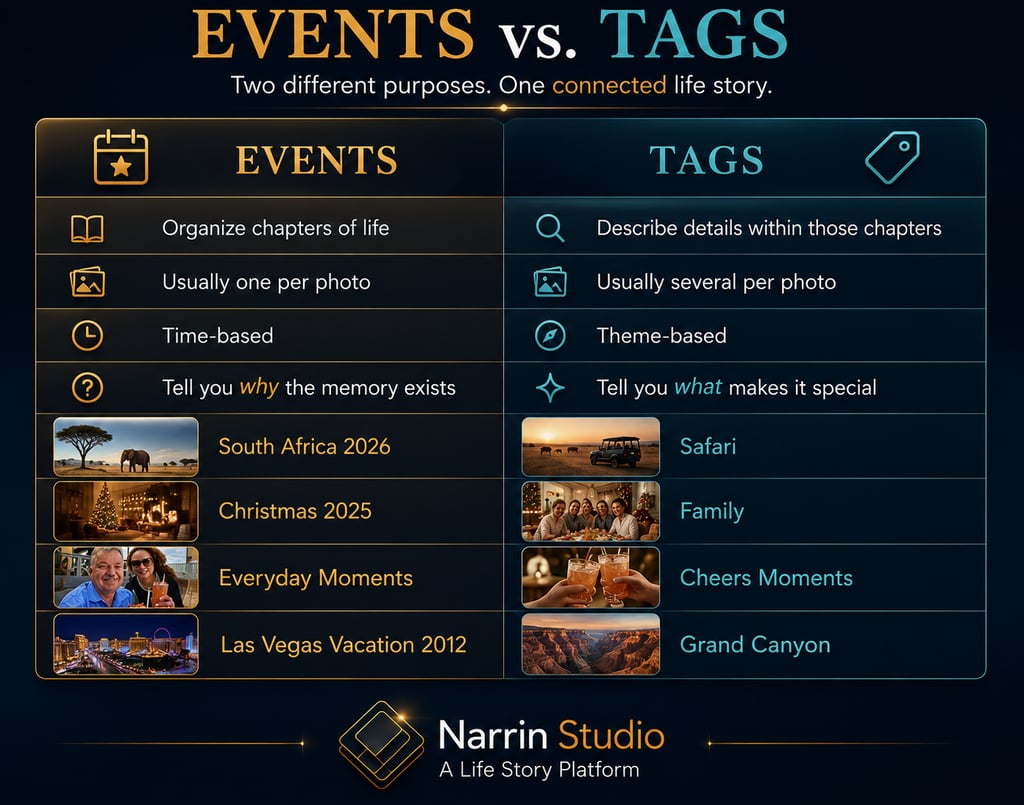
Events naturally create chronological stories.
For example:
Minneapolis Weekend.
South Africa 2026.
Alaska Cruise.
Family Reunion.
Christmas 2025.
Each Event becomes a chapter in your life.
Together they form your timeline.
Tags Build Connections
Tags ignore time.
Instead, they connect memories by theme.
Imagine creating slideshows such as:
Every Sunset.
Every Safari.
Every Baseball Game.
Every Favorite Restaurant.
Every Motorcycle Ride.
Every Dog Walk.
Every Family Celebration.
Every Cheers Moment.
Those memories might span decades, yet Narrin brings them together instantly.
People Add Another Dimension
People work much like Tags.
They connect photos across your entire collection.
Imagine creating a slideshow that follows your daughter from childhood to graduation.
Or watching every adventure you've shared with your spouse.
Or revisiting every walk with Sasha.
People aren't limited to those physically appearing in the photo.
During our visit to the Nelson Mandela House in Soweto, we added Nelson Mandela as a person connected to that memory.
He isn't in our photograph, but he is central to its meaning.
That extra layer of context transforms a sightseeing stop into part of a much deeper story.
Traditional Albums vs. Narrin
A traditional photo album answers:
"When was this picture taken?"
Narrin answers:
Where were you?
Who was there?
Why did this memory matter?
What chapter of your life was it part of?
How does it connect to memories from years before or after?
That's the difference between organizing photos and preserving memories.
Your Photos Stay Where They Are
One of Narrin's most important principles is simple.
Your photos belong to you.
Whether they live in OneDrive, Google Photos, Apple Photos, Dropbox, a NAS, or a local drive, Narrin leaves them exactly where they are.
Instead of duplicating your library, Narrin adds intelligence around it through Locations, Events, People, Tags, and Timelines.
Conclusion
Every photograph tells part of a story.
Events tell the chapter.
Tags tell the details.
People connect relationships.
Locations place memories on the map.
Together, they transform thousands of disconnected images into one connected life story.
Because photos deserve more than storage.
They deserve context.
They deserve stories.
They deserve to be remembered.
Key Takeaways
Events organize the chapters of your life.
Generic Events help organize everyday memories.
Tags describe what makes a photo unique.
Tags connect memories across years and locations.
People connect relationships across your entire collection.
Together, these elements transform photos into connected stories.
Frequently Asked Questions
Can a photo have more than one Tag?
Yes. Most photos benefit from multiple Tags because they describe different aspects of the memory.
Should every photo have an Event?
Ideally, yes. If there isn't a specific occasion, use a Generic Event such as Everyday Moments or Family Memories.
Can a Tag appear in multiple Events?
Absolutely. That's one of Narrin's greatest strengths. A Tag like Sunset or Favorite can connect photos across many different Events.
Why separate Events and Tags?
Because they answer different questions. Events organize the story, while Tags connect themes across the story.