

More Than a Place
How Narrin's Location Maps Bring Forgotten Memories Back to Life
MEMORY INTELLIGENCE
Manfred Maiers
6/15/20263 min read
More Than a Place: How Narrin's Location Maps Bring Forgotten Memories Back to Life
Thousands of Photos. Countless Forgotten Stories.
Most of us have thousands, even tens of thousands, of photos stored across phones, cloud drives, external hard drives, and old computers.
Family vacations.
Weekend adventures.
Special celebrations.
Once-in-a-lifetime experiences.
Yet despite having all these images, many memories slowly fade.
You may find a photo and immediately recognize a face, but struggle to remember exactly where it was taken.
Was it Thailand?
Was it on that cruise?
Which lake was that cabin on?
What year was it?
Why was that moment important?
The photo survived.
The story didn't.
This is one of the biggest challenges in modern digital memory preservation.
The Missing Piece in Traditional Photo Software
Today's photo management tools are excellent at storing images and increasingly good at searching them.
You can search for:
Beach.
Dog.
Birthday.
Mountain.
Sunset.
Some systems even show location metadata.
But typically that location is presented as a simple text field:
"Thailand"
"Florida"
"London"
"Minnesota"
While technically correct, these labels often fail to trigger the deeper memories connected to the experience.
Because memories are rarely attached to countries.
They're attached to places.
The exact bridge.
The favorite restaurant.
The family cabin.
The hiking trail.
The spot where something meaningful happened.
Why Places Trigger Memories
Psychologists have long understood that human memory is strongly connected to location.
A place serves as an anchor for experiences.
When people revisit a location physically, memories often come rushing back.
The same effect can happen visually.
Seeing a map and recognizing the exact location where a moment occurred can instantly reconnect us with details that were otherwise forgotten.
Who was there.
What happened.
What was said.
How it felt.
This is where Narrin takes a completely different approach.
Introducing Narrin's Visual Location Experience
Narrin does not treat location as hidden metadata.
Narrin transforms location into part of the memory itself.
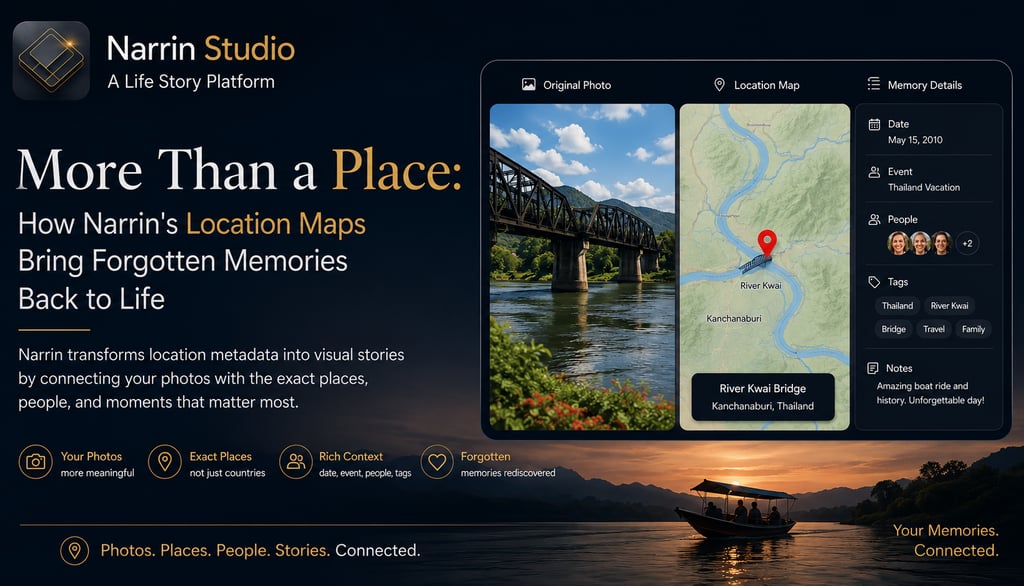
Using Narrin's unique multi-panel memory view, users can see:
Original Photo
The image remains the centerpiece.
Location Map
A visual map displays the exact location associated with the memory, complete with a location pin.
Memory Context
Additional context including:
Date.
Event.
People.
Tags.
Together, these elements create a complete memory experience rather than a simple photo display.
The result is immediate recognition and deeper emotional connection.
From Thailand to River Kwai
Imagine finding a photo from a trip taken fifteen years ago.
The image shows a bridge crossing a river.
Without context, you might only vaguely remember where it was taken.
Traditional software may display:
"Thailand"
Narrin displays:
Thailand.
River Kwai.
Exact bridge location.
Visual map with location pin.
Suddenly the memory becomes vivid again.
The hotel.
The boat ride.
The conversations.
The people who traveled with you.
One location pin unlocks an entire story.
The Family Cabin That Became a Time Machine
Many families have special places that become part of their identity.
A cabin.
A lake home.
A campground.
A family farm.
These places often hold decades of memories.
Narrin's integrated map editor allows users to create custom location maps.
Instead of showing a generic location, Narrin can display:
The property map.
The cabin location.
The dock.
The fishing spot.
The swimming area.
A childhood photo instantly becomes connected to the exact place where those summers were spent.
The result is not simply photo organization.
It's memory preservation.
Beyond Maps: Custom Memory Locations
Narrin goes far beyond traditional mapping systems.
Users can create personalized location experiences using virtually any image.
Examples include:
Cruise ship layouts.
Resort maps.
Wedding venue maps.
Campground maps.
Theme Park maps.
Historical maps.
Property layouts.
Imagine viewing a cruise photo alongside a ship deck plan with a pin showing the exact location where the memory occurred.
No traditional photo organizer provides this level of storytelling context.
Why This Changes Memory Discovery Forever
Most photo software focuses on helping users find images.
Narrin focuses on helping users rediscover memories.
There is a critical difference.
Search answers questions.
Stories create emotional connections.
By combining:
Photos.
Location maps.
Dates.
Events.
People.
Tags.
Narrin transforms isolated images into connected life experiences.
Every photo becomes part of a larger story.
Every location becomes a memory anchor.
Every rediscovered image becomes an opportunity to relive a meaningful moment.
The Future of Memory Preservation
The average family possesses thousands of photos documenting their lives.
Yet many of these memories remain hidden in folders, forgotten and disconnected from the stories behind them.
Narrin changes that.
Because memories are not just pictures.
They're people.
They're places.
They're experiences.
They're stories.
And sometimes all it takes is seeing the exact location where a memory happened to bring the entire story back to life.
With Narrin, you're not simply organizing photos.
You're rediscovering your life story, one memory at a time.